Top Ad Network Trends 2026: EVADAV’s Take on Leadership in Affiliate Marketing
Traffic in 2026 doesn’t forgive old habits. Although some advertisers are seeking growth using traditional methods, the market is evolving under the influence of mobile traffic, social networks and messengers, a new model of push ads, and increasing concerns about traffic quality and digital fraud.
In this article, we’ll discuss the main affiliate marketing trends of 2026. EVADAV experts will share their opinions about market shits and explain why human expertise is still the king.
From Traditional SEO to GEO Optimization
SEO optimization is still important, but Google and search engines alike have been losing their near-monopoly on traffic generation. AI-powered search tools have changed the game. There is a greater emphasis on answers in apps, social media, and even AI assistants rather than in traditional search engines.
As a result, two major affiliate marketing trends are growing fast in 2026:
-
Hyper-local intent (queries like “near me”, specific locations, niche segments)
-
GEO (Generative Engine Optimization) – optimizing content for AI systems so they reference and recommend your brand
In chats with AI, user queries are changing. They are becoming longer and less structured. They are also becoming voice-based and do not follow a keyword-based structure.
|
SEO queries |
GEO queries |
|---|---|
|
Buy popunder traffic |
Prepare a list of reliable ad networks where you can buy popunder traffic without bots and with good reviews. |
|
In-page traffic prices |
Which ad network currently offers the best prices for in-page traffic, and what minimum budget is needed for a proper test? |
|
Monetize push traffic |
I’m new to affiliate marketing. How can I properly launch push traffic in an ad network, which formats should I choose, and how can I avoid losing money during the first tests? |
This shift changes the acquisition strategy, too. It’s no longer about ranking for broad keywords – it’s about owning a specific niche and being clearly understood by AI systems. Natalia P., COO of an Ad Network, notes:
EVADAV Ad Network witnesses these changes through the actions of our partners and advertisers. They are approaching us not only through classical search engines but also through AI tools. They are asking very specific questions, like "where to buy popunder traffic" or "where to buy in-page traffic," using AI tools and search results. This is a key point for affiliate marketers: if the audience is starting to look for solutions through AI tools, the product should be present there as well.
But does this mean the market has already completely moved away from traditional SEO?
It is still too early to make such a statement. What is happening instead is that SEO is no longer one of the pillars, and the market is gradually learning to work within this new model of traffic acquisition. What was previously possible by relying on traditional channels and approaches is now becoming a more precise formula, where more and more focus is being placed on creatives, the funnel, and how the product is being positioned to the audience, and what it is solving for them specifically.
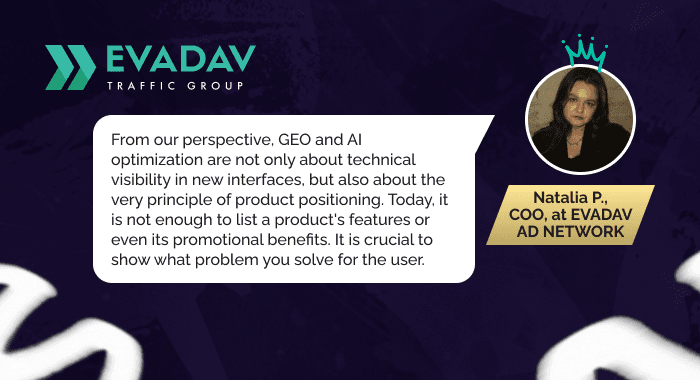
This is precisely what is becoming increasingly important in the context of AI search. The algorithm is not simply trying to determine the right keywords but rather trying to find the most relevant answer to a query. Therefore, the trend toward Answer and Generative Engine Optimization (AEO & GEO) is not a rejection of SEO but rather a need to adapt to a new search and decision-making logic.
Ultimately, it’s important to optimize for people and to communicate in the language of their needs. Advertisers who stay present in the environment where the user is searching for answers will succeed in the upcoming years.
First-Party Data and Privacy-First Tracking: Trust Matters
Recently, EVADAV Ad Network has noticed that, in the market, data and privacy-first tracking are not only very important but also a sensitive issue. Users are becoming more aware of how data is resold, how the funnel works, and how it is used in the background.
However, as Natalia also mentioned, maturity levels differ: it all depends on the advertisers – the scale, the processes they have, and how they work with data.
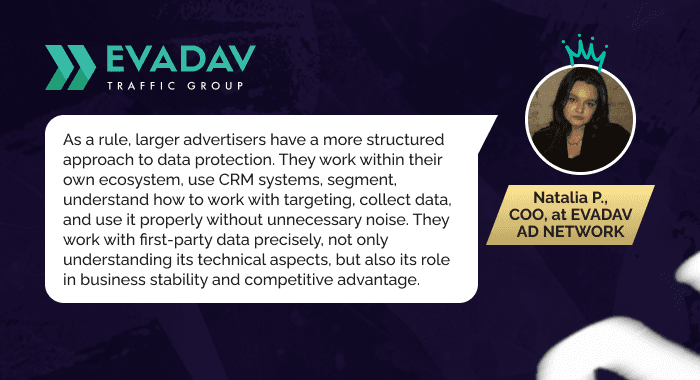
For smaller advertisers or those new to affiliate marketing, the situation is quite different. For them, data management often presents challenges. This is where the ad network's role becomes especially important: well-established platforms deliver all the conversions the advertiser needs. EVADAV Ad Network does exactly that.
The problem of data privacy is especially acute in certain verticals, for example, in the iGaming niche. Advertisers aren’t willing to share deeper financial conversion data because the market is extremely competitive and the data is considered an asset. Therefore, trust between partners remains the key.
From the technological point of view, everything remains the same. We continue to integrate natively with major ad trackers popular in different GEOs. These trackers allow advertisers to obtain the necessary conversion data directly in the EVADAV interface, with 2 postback goals available. The tracker and the necessity to share the data are always up to the advertiser.
All in all, ad networks should understand that it isn’t about collecting as much first-party data as possible – it’s about using the available data more effectively. This is where human expertise is as important as AI-driven analytics.
Automation in Media Buying: Expectations vs Reality
In previous years, AI and algorithms have become the dominant force in handling routine media buying tasks. This allowed media buyers to focus on funnels, landing page optimization, and unit economics.
It may look like a complete shift towards automation is the dominant trend in media buying for 2026. However, the data suggests that this isn’t the case. Around 30% of agencies, brands, and publishers had adopted a comprehensive AI solution for their marketing campaigns in 2025. Another report by Supermetrics suggests that only 6% of marketers have fully adopted AI, but 80% feel they need to do so.
Why is the adoption of AI not a straightforward process for media buying and performance marketing?
This was discussed with Nikolay V., Team Lead of Media Buying, EVADAV:
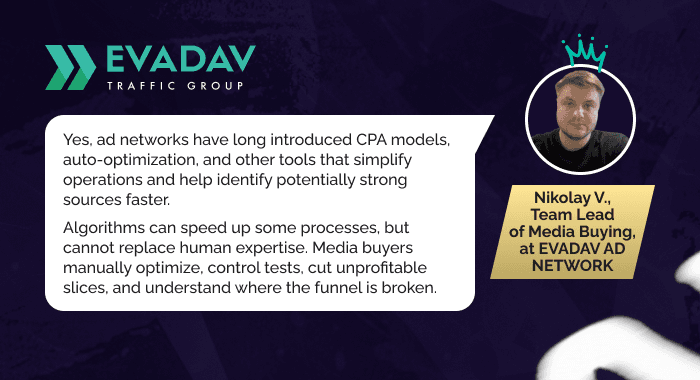
It’s not just about using AI – experts should still control processes to avoid bots creating even more chaos. AI can speed things up, but results still depend on the team. Achieving success means quick testing, controlling traffic quality, creating white and black lists, working with landing pages, avoiding over-reliance on a single network, and scaling only successful setups.
Also, as Nikolay points out, the success of a campaign cannot be measured solely by CPA/CPC. Successful media buying relies on a multi-variable approach: browser targeting, OS targeting, language targeting, conversions by funnel stages, CTR, click-to-lead, click-to-sale, and the quality of the ‘creative + landing’ pair. One of the main areas where the campaign can be broken is the landing pages. Even slight changes, such as a few words on a page, can have a significant impact on conversion rates.
Bots and AI agents: two sides of the same coin
Traffic quality remains a major problem in 2026. Sometimes it seems like everything is going fine at the start, with lots of installs or trials. But then it just falls apart when people get to the payment part or whatever the main goals are. That leads to wasting money. One thing causing this is bots sneaking in.
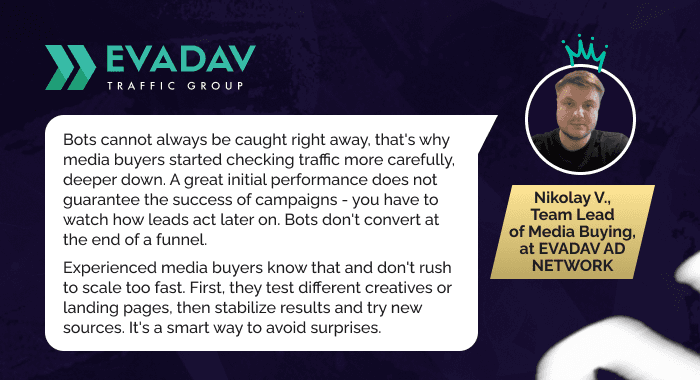
On the other hand, not all bots are malicious. For example, some AI agents handle the whole shopping process, from looking things up to buying, and corporations are actively using this stuff:
-
Amazon launched the beta feature Buy for Me in 2025
-
OpenAI introduced Buy it in ChatGPT and Agentic Commerce Protocol
-
Microsoft launched the Copilot Merchant Program and positions Copilot as a “personal shopper”
This opens doors for ad networks – they can capture AI traffic by presenting the product comprehensively. To stay competitive, advertisers need:
-
Structured data and clean feeds
-
Clear, task-oriented messaging
-
Transparent offers (pricing, bonuses, trials)
-
Strong trust signals (brand, reviews, consistency)
Such an approach allows appealing to both AI-shoppers and a human audience who will see how exactly products solve their problems and pains.
Domination of Mobile, Social, and Messengers
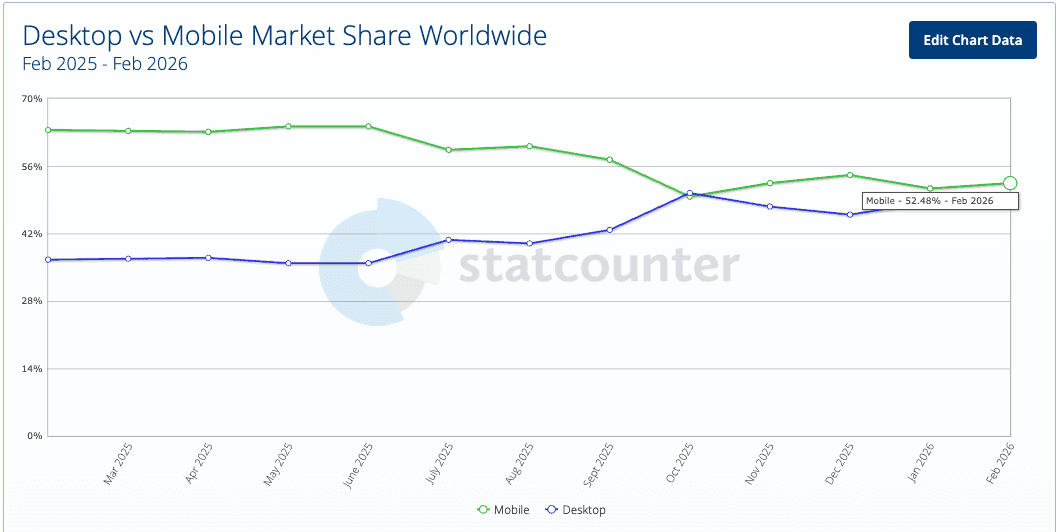
Source: https://gs.statcounter.com/platform-market-share/desktop-mobile/worldwide/
Mobile traffic dominance is becoming undeniable. According to StatCounter, in February 2026, smartphones and tablets generated 52.26% of global web traffic, winning over desktops. This makes mobile-first no longer a recommendation, but a baseline.
Social platforms and messengers have also become the main environment for digital interaction. DataReportal reports 5.66 billion social media accounts globally, with 97.3% of internet users engaging with at least one platform monthly. In July 2025, messaging apps ranked above search engines among the most popular online platforms for internet users:
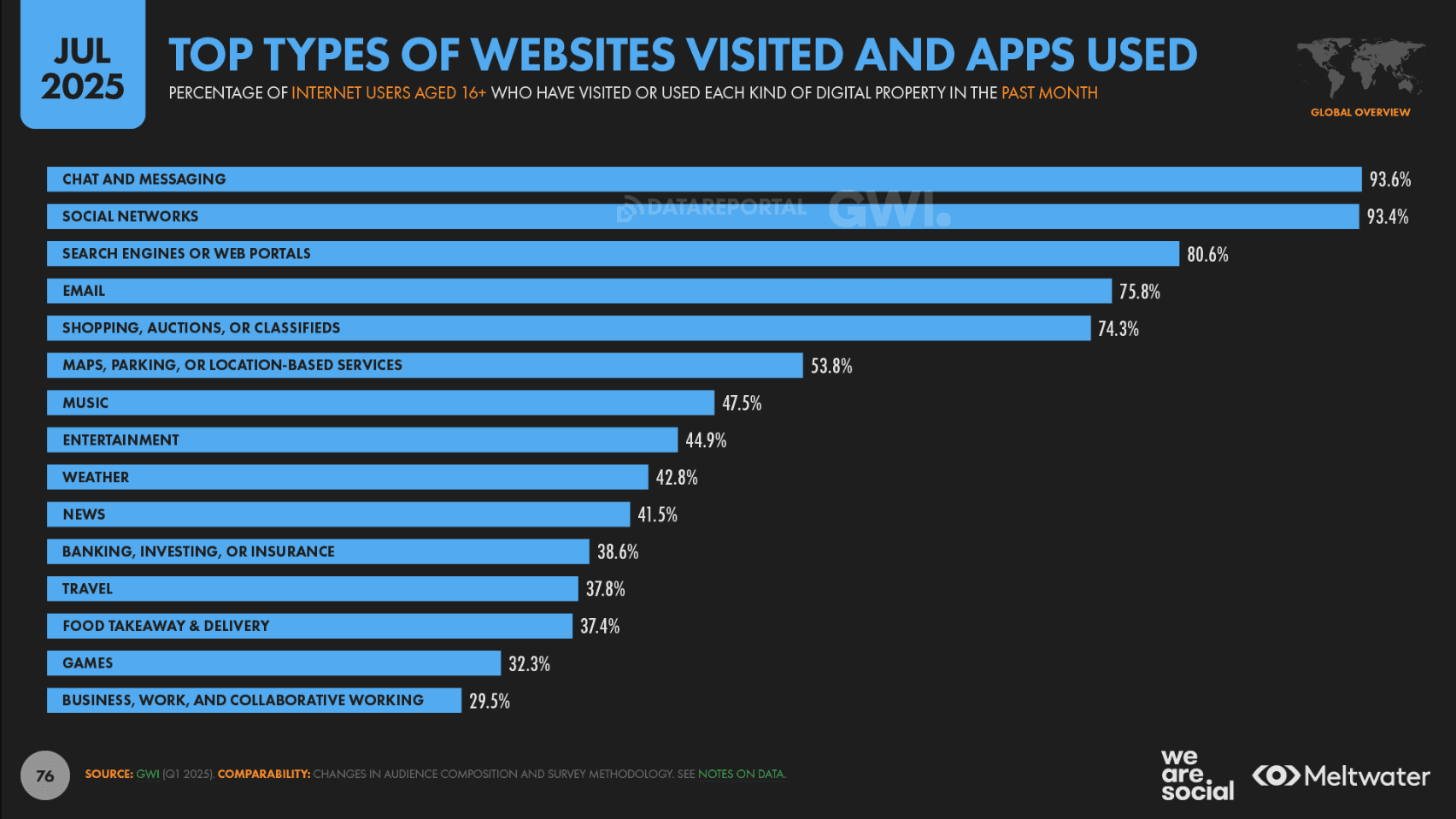
For advertising, this signals where attention is concentrated: feeds, short-form video, chats, and online communities – where both traffic and conversions originate and grow. Within EVADAV, a lion’s share of traffic comes from mobile devices. For many of our advertisers, this is no longer a trend, but the standard.
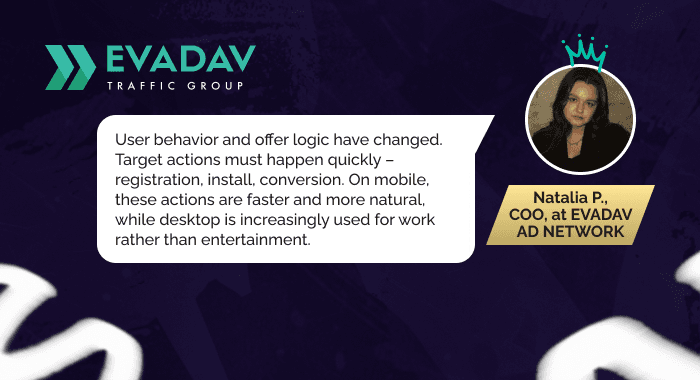
Top-performing mobile verticals:
In offers from those verticals, it is essential to move users through the funnel as fast as possible. That’s why mobile traffic behaves naturally and converts better in this case. We also see this effect in some GEOs, for example, in India, where people mostly use the internet on their mobile phones, not on computers or tablets.
We also observe the same effect on the ad format level. On mobile, simple and fast formats work best, requiring minimal effort from the user. We see that push, in-page, and popunder are the most successful in this case. Popunder is performing well in terms of volume and conversion rate, and in-page is becoming more popular as a reliable alternative to push when traffic quality isn’t as stable.
The classic messenger traffic is also increasing, but it’s crucial to choose reliable platforms. For example, TMA (Telegram Mini Apps) remains an expensive channel with moderate traffic volumes, so conversion isn’t always worth the money spent. At EVADAV, see that social traffic can be more rewarding if one knows how to deal with certain challenges:
-
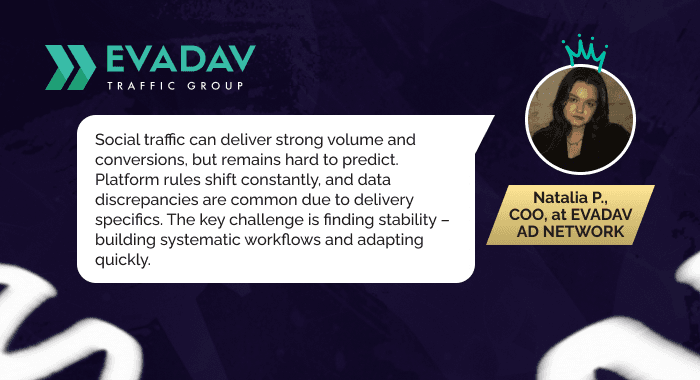
The biggest problem with social traffic is its unpredictability. It may send good volume and conversion, but rarely stability. The rules of each platform change frequently. Moreover, they may vary for various platforms within the same domain, for example, different rules apply across Meta's projects. Among all platforms, X (Twitter) is the least predictable.
-
The difficulty with attributing and tracking social traffic stems from mismatches in data that often result from various factors.
EVADAV Ad Network is already adapting to these shifts. Alongside Direct Link, we’re developing a dedicated solution for social traffic – Social Link – made to improve attribution accuracy, tracking, and handling of data discrepancies.
At the same time, we continue to adjust the internal inventory to the ongoing dominance of mobile traffic. This includes deeper targeting, expanded source capabilities, and a stronger focus on giving advertisers greater transparency when building funnels based on mobile user behavior.
Multiformat approach and Ad Personalization
In recent years, ad networks have shifted from a singular format and revenue source model towards a diversified monetization model. It isn’t enough for advertisers to work with different formats – they also need to analyze the performance of formats, content types, GEOs, and devices. This is supported by industry studies and practical examples.
For example, even a single demographic data point allowed the Financial Times to sell inventory at an average CPM that was 45% higher than for inventory without such targeting. Administration also highlights that, in today’s environment, a multi-format, multi-channel approach is no longer optional. A similar view is shared by INMA, which describes revenue diversification as a key response to market instability.
Valentin B., Chief Revenue Officer at EVADAV Ad Network, shares his perspective on the multi-format trend. In practice, it’s not about launching every format at once – the process is much easier:
-
In most cases, an advertiser or affiliate will start with the simplest and most cost-effective entry point. With a low budget and being in the testing phase, popunder is usually the entry point. It provides easy access to a large volume of traffic, validates GEOs, and provides a clear signal about the offer's viability.
-
Further steps depend on budget, experience, and results. Some scale horizontally across GEOs, while others move toward more precise and higher-cost formats, such as in-page, push, or native.
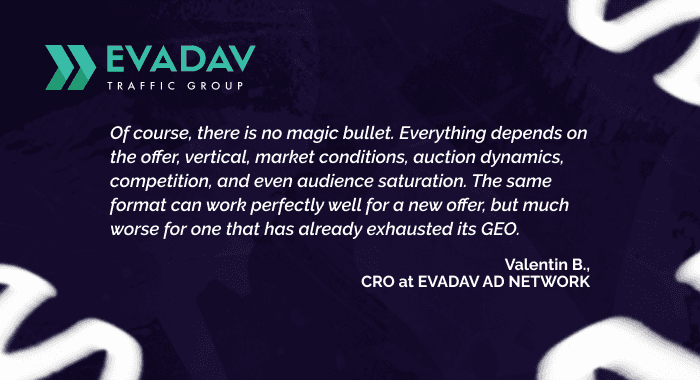
Creating a multi-format strategy is a gradual process. First, a working entry point is discovered, and then additional formats are added, coverage is expanded, and a more complex model of buying or monetization is developed. Of course, a lot depends on people – managers, specialists, close communication with partners, postback, and a proper understanding of what kind of traffic the offer needs and what actually brings money.
Push Ads 2.0: Evolution, Not Replacement
The term “Push 2.0” is already in use in the market, though only as a convenient label for a new, updated methodology rather than a fundamentally new format.
Here, we are witnessing two facts:
-
Yes, Push Ads have become less effective and are increasingly restricted by platforms. Google is continuing to update its policies and introduce new limitations.
-
At the same time, push stays one of the most stable formats, and as long as this functionality is maintained, it will continue to work effectively.
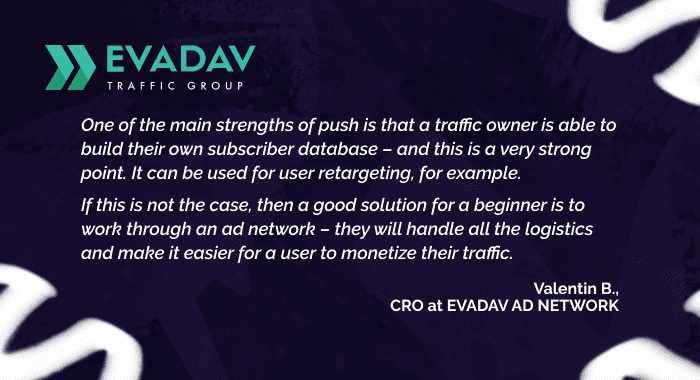
Push ads can be a stable, effective tool that brings users back into the funnel and generates revenue when used correctly. At the same time, its efficiency can be improved by moving toward more personalized, behavior-driven scenarios. Once again: keep optimizing for real people, not only bots.
Summing Up: Human Expertise Still Matters
Despite rapid technological advancements and the need to automate, human expertise remains an important factor in ad network development. To be effective, AI agents should be controlled by human experts – buyers, managers, and traffic experts. This is an indicator of a broader 2026 trend in affiliate marketing. We’re not moving to a highly automated model – instead, we value strong teams.
Also, we discussed the following trends:
-
Traffic quality is more important than top-of-funnel metrics. Clicks, installs, trials, and even high CR aren’t a guarantee of real performance. In fact, quality may be determined only at the payment stage, FTD, repeat conversion, etc
-
Ad networks are more affected by platform regulations. Decisions made by major ecosystems, especially Google, have a direct impact: browser restrictions, moderation, domain bans, and changes to search and ad-serving policies. This requires constant, rapid adaptation on our part.
-
Adapting creatives and landing pages to the traffic is now a growth factor. In fact, the same offer can no longer be promoted in the same way across all GEOs, browsers, and traffic sources. More emphasis is now being placed on adapting the offer to different markets and traffic sources.
Explore Trends with EVADAV Ad Network
2026 has already proven that the advertising and traffic market doesn’t stand still, and to grow, one needs not only to increase the budget but also to have a reliable technology partner who understands the changes in formats, sources, and users.
Our Ad Network team is constantly working to improve both tools and expertise to grow alongside our clients.
The most practical way to test trends of 2026 is to join EVADAV Ad Network and start running campaigns with us.
If you want to stay up to date with the latest trends and technologies, read our blog – we share useful insights on the AdTech industry 👈